
Home Workout With No Equipment: A 20-Minute Full-Body Plan
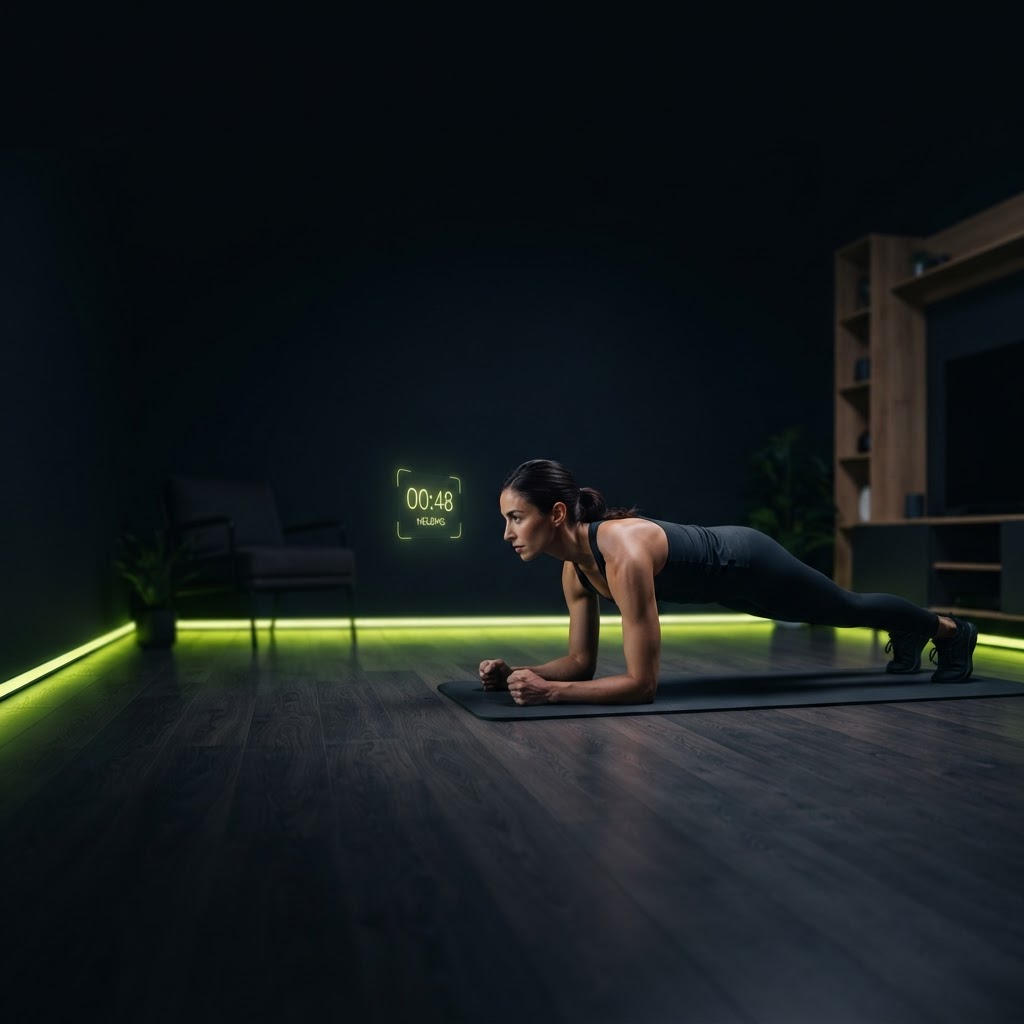
You do not need a gym to train effectively. You need a sequence of movements that load your muscles hard enough, in an order that keeps your heart rate up, inside a time window you will actually honor.
Here is a 20-minute full-body session that requires nothing but floor space — and the reasoning behind each block so you can adjust it as you get stronger.
The structure: five blocks, four minutes each
Each block pairs a strength movement with a short, controlled rest. Move with intent for 40 seconds, rest 20, repeat four times, then take a full minute before the next block.
Block 1 — Squat pattern
Bodyweight squat or split squat. Stand tall, sit back and down, drive through the whole foot. If bodyweight feels easy, slow the descent to three seconds and pause for one second at the bottom. Tempo is free resistance.
Block 2 — Push pattern
Push-up or incline push-up. Keep a straight line from ears to heels, elbows at roughly 45 degrees. Too hard? Elevate your hands on a chair. Too easy? Elevate your feet.
Block 3 — Hinge pattern
Single-leg hip bridge or good morning. Hinging at the hips trains the posterior chain, which protects your lower back and carries over to almost every other movement.
Block 4 — Pull pattern
The hardest pattern to train without equipment. Use a towel row under a sturdy table, a doorframe row, or a prone swimmers hold if neither is available. Squeeze the shoulder blades before you bend the elbows.
Block 5 — Core and conditioning
Plank shoulder taps, dead bugs and a fast mountain climber. Alternate for four rounds. This is where your heart rate peaks, so keep the core work controlled and the climbers quick.
Why this order works
Large, multi-joint movements come first while you are fresh, isolation and core work come last, and every block alternates between a strength pattern and a brief recovery window. That keeps quality high without turning the session into a forty-minute slog.
How to progress without weights
Bodyweight training progresses through leverage, range and tempo rather than load:
- Add time under tension. Slow the lowering phase of every rep.
- Reduce your base of support. Move from two legs to one, or from knees to toes.
- Increase range. Deeper squats, lower push-ups, fuller hip extension.
- Shorten rest. Cut the 20-second break to 15 once the block feels comfortable.
Change one variable at a time, and only when the current version feels genuinely easy for two sessions in a row.
Making it a habit
- Same time, same place. Train where the equipment already is — which for this session is anywhere.
- Keep the session on your calendar as a 20-minute block. A short entry is easier to defend than a vague intention.
- Log what you did. Even three lines is enough to see progress and decide when to progress.
The bottom line
A home session works when it is structured, progressive and short enough to repeat three times a week. Twenty focused minutes, three times a week, beats an hour you keep postponing.
Start your free FitnessPallo trial and generate a home plan that adapts to the equipment you have — including none.
This article provides general fitness information and is not a substitute for professional medical advice.
This article provides general fitness and wellness information and is not a substitute for professional medical advice. See our Fitness Disclaimer.