
Personalized Workout Planner: Build a Week That Fits Real Life
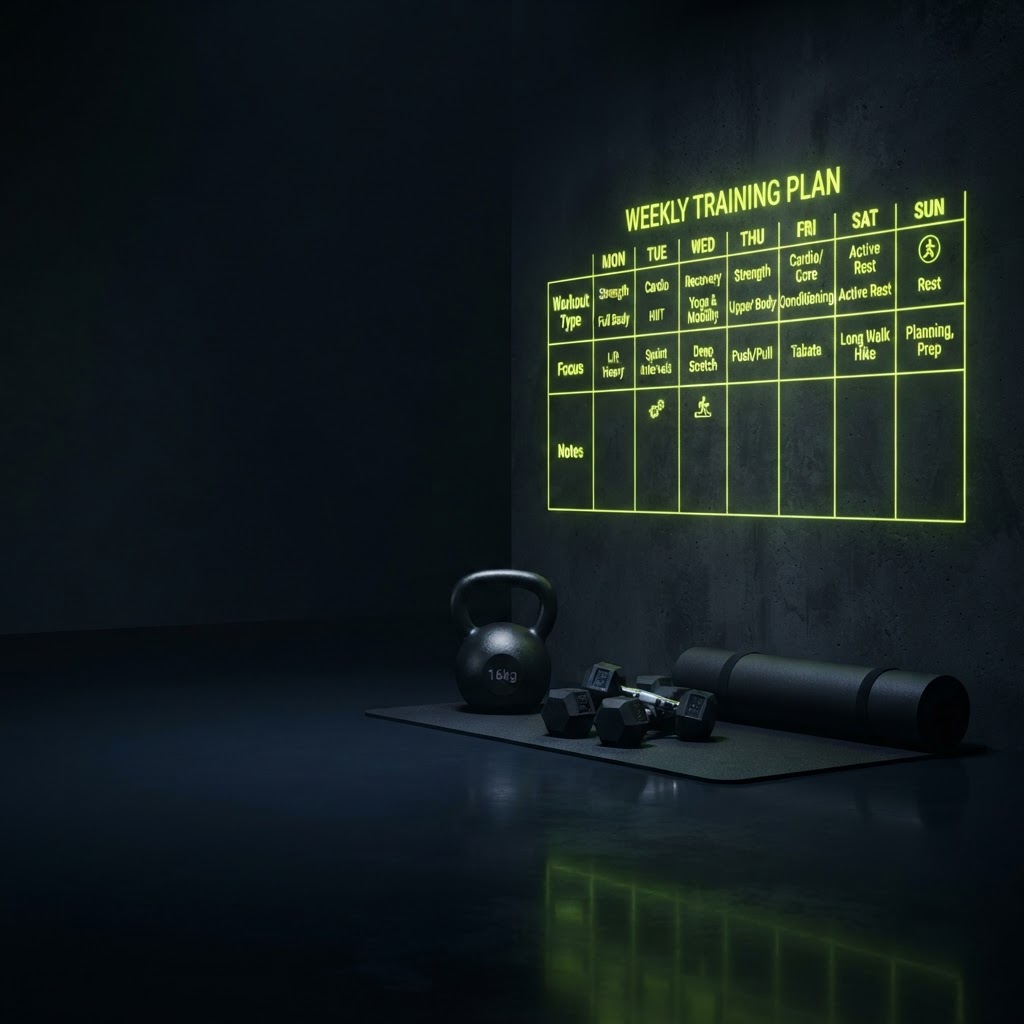
Most training plans fail on Wednesday. Monday was great, Tuesday was fine, and then a late meeting, a tired morning and a family obligation turn a five-day plan into a two-day plan — and by the following week it feels like you have fallen behind.
The problem is not your discipline. The problem is that the plan was built for an ideal week that does not exist. A personalized workout planner starts from the week you actually have and builds the training around it.
Start with your real week, not a template week
Before choosing a single exercise, answer three questions honestly:
- How many sessions can I truly repeat? Two sessions you never miss beat five you frequently skip. Consistency is the variable that produces results.
- How long is each window? If your realistic block is 35 minutes, plan 35-minute sessions — including warm-up.
- Which days are fixed? Anchor training to the days that rarely change, then treat the rest as bonus sessions.
Write those answers down. That is the skeleton of your plan.
Build the week around movement patterns
A balanced week distributes work across patterns rather than chasing individual muscles:
- Squat — a knee-dominant movement such as a goblet squat or split squat
- Hinge — a hip-dominant movement such as a Romanian deadlift or hip bridge
- Push — pressing overhead or horizontally
- Pull — a row or pull-up variation
- Carry or core — loaded carries, planks, dead bugs
With three sessions a week, a simple structure is full body, full body, full body — each one touching most patterns. With four, an upper/lower split works well. With five, you can afford a dedicated arms or conditioning day without neglecting anything else.
Decide the intensity before you walk in
Plans often fail because every session is treated as a maximum-effort day. Instead, label each session in advance:
- Heavy day — lower reps, more rest, focus on load
- Moderate day — the workhorse session, two to three reps shy of failure
- Easy day — mobility, technique, or a short conditioning piece
Most people can handle one heavy day, one moderate day and one easy day per pattern each week and still recover. Skipping the easy day is the most common reason progress stalls.
Let the plan adapt instead of breaking
Real weeks change. A good planner has an answer for the day everything moved:
- Shorten before you skip. A 15-minute version of the session keeps the habit and most of the stimulus.
- Swap location, not intent. Travelling? Replace the gym session with a bodyweight version of the same patterns.
- Reorder, do not delete. If Thursday collapses, push the session to Saturday and drop the lowest-priority accessory work.
An adaptive plan absorbs disruption. A rigid plan treats one missed day as a failed week.
Track two numbers only
You do not need a dashboard full of metrics. Track the load and reps for your main lift in each pattern, and track how many sessions you completed. Those two numbers tell you whether you are progressing and whether you are consistent — the only two questions that matter in the first three months.
Your first week, in one line
Three full-body sessions, one heavy and two moderate, each 35 minutes, built from the equipment you already have, with the fourth day reserved as a make-up slot.
That is a plan you can finish. And a plan you can finish is the only kind that changes anything.
Start your free FitnessPallo trial and generate a week built around your schedule, equipment and recovery.
This article provides general fitness information and is not a substitute for professional medical advice.
This article provides general fitness and wellness information and is not a substitute for professional medical advice. See our Fitness Disclaimer.